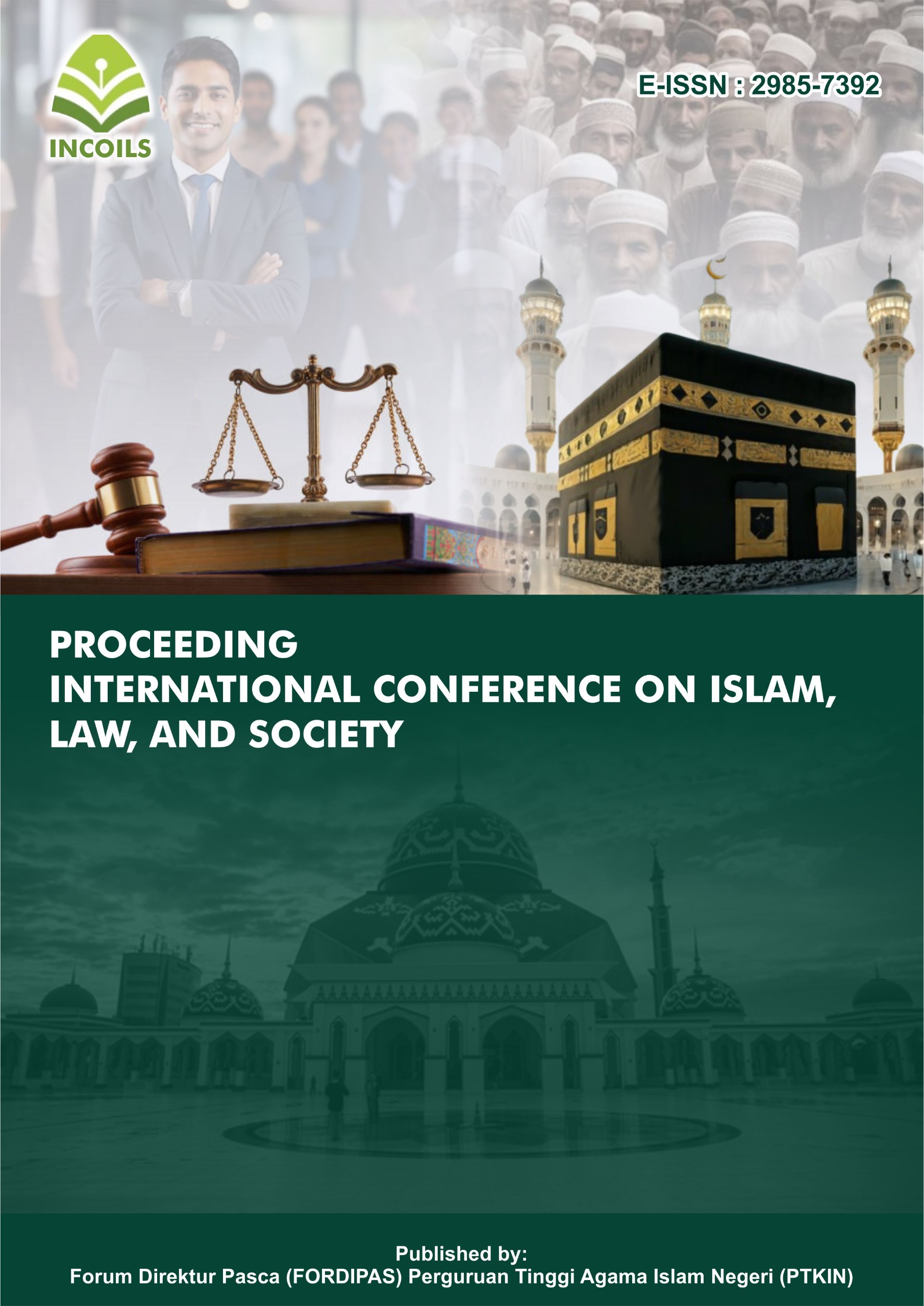
Reinterpretation Resolution of Nusyuz and Syiqaq in the Qur'an: A Gender Justice and Restorative Approach
DOI:
https://doi.org/10.70062/incoils.v5i1.325Keywords:
Nusyus and Syiqaq, SettlementAbstract
This study discusses the perspective of the Qur'an in dealing with nusyuz and domestic disputes by highlighting its relevance to the increase in family conflicts and divorce. The study emphasizes the importance of reinterpreting religious texts to be in line with the principles of justice and gender equality. Using literature review and content analysis methods, data was collected from classical to contemporary literature discussing nusyuz and syiqaq. Descriptive-analytical analysis was conducted through an examination of the meaning of verses, historical context, and the views of classical and modern exegetes to explore the relevance of their application to contemporary family life. The results of the study show that the Qur'an offers a gradual, rational, and humanistic mechanism for conflict resolution through advice, separation of beds, and family mediation (tahkim). This approach is not only normative but also adaptive to modern social dynamics, especially regarding the values of justice, equality, and peace. The understanding of nusyuz has also evolved, no longer limited to the behavior of wives, but also including the negligence of husbands in carrying out their moral, spiritual, and emotional responsibilities. This research contributes to strengthening the principles of justice and benefit in Islamic family law and provides practical guidance for religious institutions such as the KUA and religious courts in handling domestic disputes more effectively.References
Afifah, Nurul, and Asni Mulya Fitri. “Nusyuz In Islamic Law: Comparative Analysis Between
Sanctions And Responsibilities Of Women And Men” 8, no. 12 (2024): 176–87.
https://doi.org/10.30659/budai.1.1.13-23.6. (Journal Online)
Al-Mawardi, Abu al-Hasan. Al-Nukat wa al-Uyun. (Tafsir Al-Mawardi). Beirut: Dar Al- Kutub AlIlmiyyah, 1992, 1992. (Book)
Al-munir, Wahbah Az-zuhaili The Tafsir, and Naeni Masitoh. “Syiqaq in The Al- Qur ’ an Surah An
-Nisa Ayat 35 Menurut” 1 (2024): 101–14. (Book)
Ala al-Uddin al-Muttáqi Bin Hisamuddin al-Hindi. Kanzūl „Umal Fi Sunani Aqwali Wal Af‟āl. Juz I,
(Book)
Ali Yusuf As-Subki. Fiqh Keluarga Terj. Nur Khozin, Jakarta: Amzah, 2020. (Book)
Angki Aulia Muhammad. Legal Awareness of Mahmud Village Community to Have Certificates for
Customary Rights, (Universitas Pendidikan Indonesia, 2013)
Http://Repository.Upi.Edu/406/6/S_PKN_0907327_CHAPTER3.Pdf 26 Sugiyono, Metodologi
Penelitian Pendidikan, (Bandung:, n.d. (Journal Online)
Auda, Jasser. Maqasid Al-Shariah as Philosophy of Islamic Law: A Systems Approach. IIIT, 2008. (Book)
———. Maqasid Al-Shariah as Philosophy of Islamic Law: A Systems Approach. London: IIIT, 2008. (Book)
Hidayat, Taufik, and Pascasarjana UIN Sultan Maulana HasanuddinBanten. “Resolution of Nusyuz
and Syiqaq Disputes in Perspective Al-Qur’an.” Jurnal Ilmiah Ahwal Syakhshiyyah (JAS) 5 (2023).
http://riset.unisma.ac.id/index.php/fai/index. (Journal Online)
Ibn ‘Ashur. Muhammad Al-Tahir. Maqasid Al-Shariah Al-Islamiyyah. Amman: Dar Al-Nafa’is, 2001.
(Book)
Jamaluddin dan Nanda Amalia. Book Law Merrride, 2016. (Book)
Kamil al-Hayali. Islamic Solutions to Domestic Conflict, 2005. (Book)
Kisyik, Abdul Hamid. Islamic Guidance to Achieve a Sakinah Family. Terj.Ida Nursida, Bandung: Al-Bayan,
(Book)
Kurniawan, Dede, and Coauthor Sayehu. “Interpretation of Verses About Nusyuz, Syiqaq and Their
Solution: Normative Psychological and Theological Approaches (An-Nisa 34-35 And 128)” 7,
no. 4 (2024). (Journal Online)
Maki, Al-. “Al-Hidayah Ila Bulughin Nihayah Fi Ilmi Ma’anil Quran.” Beirut: Darul Kutub Ilmiah 1,
no. 2 (n.d.): 210. (Book)
Masri. “Mendalami Konsep Nusyuz Dan Syiqaq Dalam Perspektif Hukum Islam: Sebab, Dampak,
Dan Solusi.” Jurnal Tahqiqa 17, no. 2 (2023): 72–48. (Journal Online)
Muhammad Diah. "The Solution to Syiqaq According to the Qur'an, Surah Al-Nisa', Verses 34-35
(A Study of the Thoughts of Al-Qurthubiy)." Al- Mabhats : Jurnal Penelitian Sosial Agama 3, no.
(2018): 241–60. (Journal Online)
Nasrulloh, Muhammad, and Mohamad Zakky Ubaid Ermawan. “Nusyūz Suami Serta Mekanisme
Penyelesaiannya Perspektif Fikih Munākaḥāt.” Syariah: Journal of Fiqh Studies, 2024.
https://doi.org/10.61570/syariah.v2i2.83. (Journal Online)
Pamungkas, alvian bhakti, and nabila thyra janitra. “_85+Alvin+Galley.” Al-Afkar: Journal for Islamic
Studies 7, no. 4 (2024): 426–39. https://doi.org/10.31943/afkarjournal.v7i4.1225.Analysis.
Prof. Dr. Wahbah Az-Zuhaili. Tafsir Munir Jiid 3, n.d. (Journal Online)
Putra, Muhammad Habib Adi, and Umi Sumbulah. “Memaknai Kembali Konsep Nusyuz Dalam
Kompilasi Hukum Islam Perspektif Gender & Maqashid Syariah Jasser Auda.” Egalita 15, no.
(2020): 42–60. https://doi.org/10.18860/egalita.v15i1.10179. (Journal Online)
Rahman. “Nusyūz Husband and Gender Justice: Rereading QS 4:128 and KHI 83–84 with a Cultural
Relativism Approach.” Jurnal Tahqiqa, 6, no. 1 (2025): 68–97. (Journal Online)
Rizka Ayu Febri. “Reformation Of Islamic Family Law In Indonesia : The Nusyuz Resolvation
Process.” ALHURRIYAH : Jurnal Hukum Islam 06, no. 2 (2021): 196. (Journal Online)
Rohman, Baeti. “Nusyūz Suami Dan Keadilan Gender: Membaca Ulang QS 4:128 Dan KHI 83–84
Dengan Pendekatan Relativisme Budaya.” Jurnal Tahqiqa, 6, no. 1 (2025): 121. (Journal
Online)
Rohman, Baeti. Nusyūz Husband And Gender Justice “: Membaca Ulang QS 4 : 128 Dan KHI 83-
Dengan Pendekatan Relativisme Budaya” 6, no. 1 (2025): 68–97. (Journal Online)
Salam, Nor. “The Concept of Nusyuz in the Perspective of the Qur'an (A Study of Maudhu'i
Tafsir)."De Jure: Jurnal Hukum Dan Syar’iah 7, no. 1 (2015): 47–56.https://doi.org/10.18860/jfsh.v7i1.3511. (Journal Online)
Sayyid Quthb. Tafsir Fi Zhilalil Qur’an; Dibawah Naungan Al- Qur’an, Terj. As‘ad Yasin, 2001.
Shihab, M.Quraish. Tafsir Al-Misbah:Pesan, Kesan, Dan Keserasian Al-Qur’an, Vol, 2, Ciputat: Lentera
Hati, 2000. (Book)
Shihab, M. Q. Tafsir Al-Mishbāḥ: Pesan, Kesan Dan Keserasian Al-Qur’an. Ciputat: Lentera Hati., 2000.
(Book)
Siti Ruhaini Dzuhayatin. Methodological Reconstruction of Gender Equality Discourse in Islam, 2012. (Book)
Zainuddin, Ummi Khairiah. “‘Nusyuz in The Al-Qur’an.’ Tafser:” Journal of Qur’anic Studies 2, no. 1
(2017): 63–73. (Journal Online)
Zehr, Howard. The Little Book of Restorative Justice. New York: Good Books, 2015. (Book)
Downloads
Published
How to Cite
Issue
Section
License
Copyright (c) 2025 Proceeding International Conference on Islam, Law, and Society (INCOILS)

This work is licensed under a Creative Commons Attribution-ShareAlike 4.0 International License.