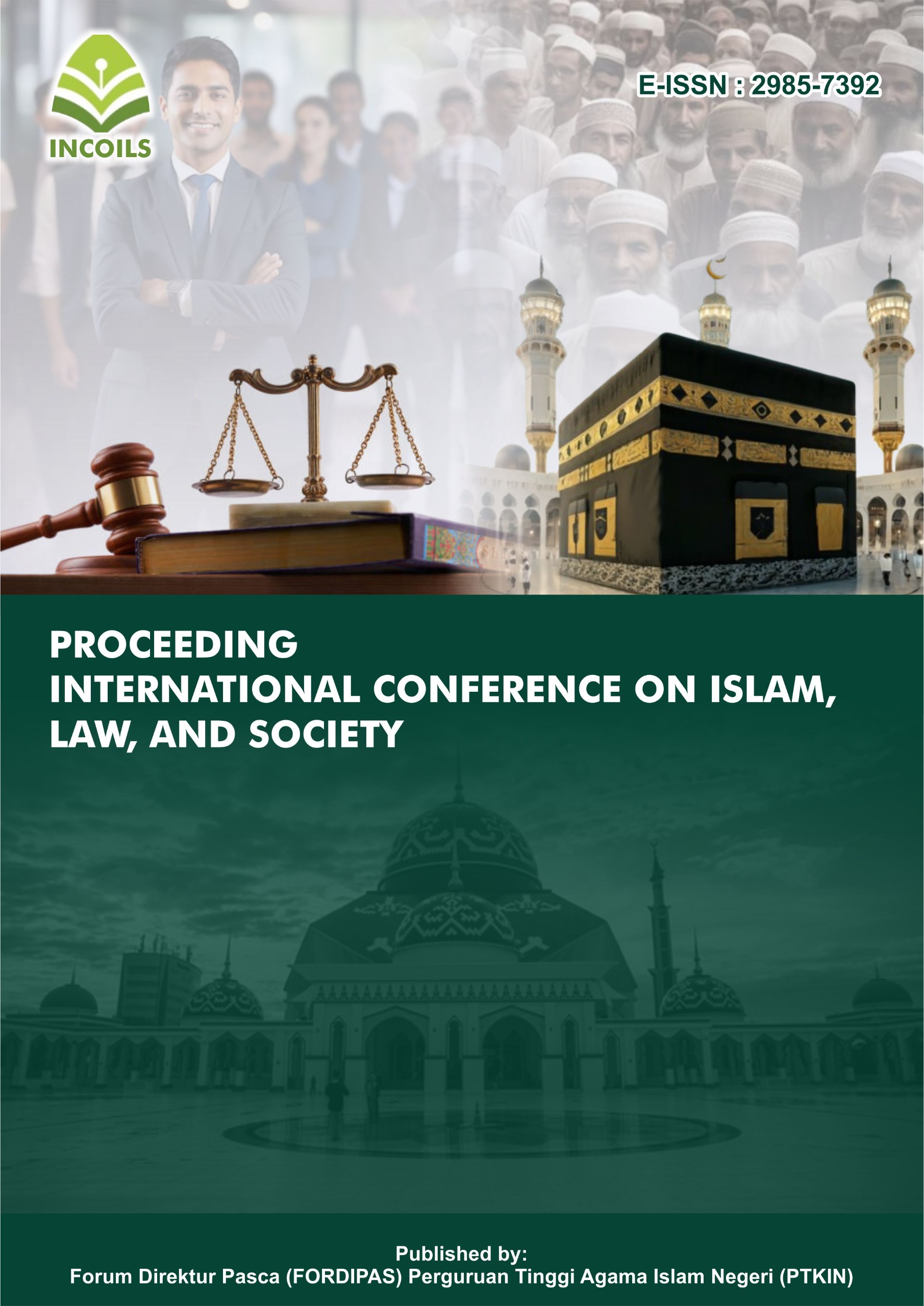
The Validity of Artificial Intelligence (AI)–Based Business Contracts from the Perspective of Islamic Economic Law and Maqasid al-Shari‘ah
Forms and Mechanisms of Artificial Intelligence (AI) Based Business Contracts in Modern Economic Practice, and The Validity of Artificial Intelligence (AI)–Based Business Contracts in the Perspective of Islamic Economic Law and Maqasid al-Shari‘ah
DOI:
https://doi.org/10.70062/incoils.v5i1.362Keywords:
Contract Validity, Business, Artificial Intelligence, Islamic Economic Law, Maqāṣid al-Sharī‘ahAbstract
ABSTRACT: The advancement of artificial intelligence (AI) technology has introduced a new dimension to modern business contracts. Amid the growing digitalization of the global economy, human roles in contractual relations have shifted from direct participants to system controllers operating through intelligent algorithms. This shift raises legal and ethical concerns in Islamic economic law regarding the validity and moral accountability of contracts executed by non-human systems. Using a normative and conceptual approach, this study examines classical fiqh muamalah principles, maqāṣid al-sharī‘ah, and Indonesian positive law. The findings indicate that AI cannot serve as an independent legal subject because it lacks volition (irādah) and moral responsibility (taklīf). AI functions only as an intermediary (wakīl bi al-tanfīẓ) executing human intent, while legal responsibility remains with the human controller. Contracts executed through AI are valid if conducted under human authorization, reflect mutual consent (tarāḍin), and are free from gharar, tadlīs, and injustice. From the maqāṣid al-sharī‘ah perspective, AI utilization is permissible when it promotes welfare, efficiency, and protection of economic rights. This study highlights how sharī‘ah values can creatively engage with technology, synthesizing classical Islamic legal traditions with the evolving dynamics of modern digital law.References
Al-Zuhayli, Wahbah. Al-Mu’amalat Al-maliyah Al-mu’asirah: Buhuth Wa-fatawa Wa-hulul. Dar al-Fikr, 2006.
« ANALISIS HUKUM ISLAM TERHADAP PENGGUNAAN TEKNOLOGI BLOCKCHAIN DALAM TRANSAKSI KEUANGAN SYARIAH », s. d.
Antonio, M. S. Bank syariah: dari teori ke praktik. Gema Insani, 2001. https://books.google.co.id/books?id=r3yFiZMvgdAC.
Arsyad, Ifan, Dona Budi Kharisma, et Jamal Wiwoho. « Artificial intelligence and Islamic finance industry: problems and oversight ». International Journal of Law and Management, 2025.
Azis, Muh Ilham, Eril Eril, Andi Muh Taqiyuddin BN, Abdul Salam, et Ahmad Arief. « MAQĀṢID AL-SHARI’AH THEORY BY IMAM AL-SYĀṬIBĪ ». ANAYASA: Journal of Legal Studies 2, no 1 (2024) : 17‑34.
Cahya, Ayuni Nilam, M. Amir Maksum, et Tubagus Akbar Satria Primadana. « Transformasi budaya hukum dalam era digital (implikasi penggunaan AI dalam perkembangan hukum di Indonesia) ». IKRA-ITH HUMANIORA: Jurnal Sosial Dan Humaniora 8, no 2 (2024) : 361‑73.
Din, Jalal al-. « Al-Asybah wa al-Nazhair fi Qawaid wa Furu’Fiqh al-Syafi’iyah », 2016.
Dwiputra, Andika, et J. Juliana. « DIGITALISASI ZAKAT: TRANSFORMASI PENGELOLAAN ZAKAT MELALUI FINTECH SYARIAH », s. d.
Gojali, Dudang. « Implementasi Hukum Ekonomi Syariah Pada Lembaga Keuangan Syariah ». AKSY: Jurnal Ilmu Akuntansi dan Bisnis Syariah 1, no 2 (2019) : 130‑43.
Gunawan, Didik. « Penerapan Smart Contract dalam Keuangan Syariah: Tinjauan Literatur tentang Integrasi Cryptocurrency dan Blockchain ». Jurnal Ilmiah Ekonomi Islam 11, no 1 (2025).
Indarta, Yose. Cyber Law: Dimensi Hukum dalam Era Digital. Pustaka Galeri Mandiri, 2025.
Islam, FIQH MUAMALAH Kajian Komprehensif Ekonomi. « FIQH MUAMALAH Kajian Komprehensif Ekonomi Islam », 2020.
« KUH Perdata », s. d.
Kurnaini, Amy Dwi, et Lailatul Rohmah. « Analisis Teori Al-Ba’i Terhadap Praktik Smart Contract Pada Platform e-Commerce ». Muslim Heritage 9, no 1 (2024) : 45‑60.
Makhmudah, Siti. « PERAN ARTIFICIAL INTELLIGENCE DALAM PENGEMBANGAN PRODUK KEUANGAN SYARIAH ». Jurnal Ekonomi Islam 2, no 2 (2025) : 340‑59.
Mas’ ut, Mas’ ut, Moh Saiful Mustofa, Alfin Yuli Dianto, et Mohamad Fuad Udin. « Model Manajemen Resiko pada Lembaga Keuangan Syariah ». Indonesian Journal of Humanities and Social Sciences 4, no 3 (2023) : 725‑40.
MUAMALAH, PERSPECTIVES OF FIQH, et TURKEY’S MAJALLAH AL. « COMPARISON OF THE HAWALAH SYSTEM FROM THE PERSPECTIVES OF FIQH MUAMALAH, TURKEY’S MAJALLAH AL AHKAM, AND INDONESIAN CIVIL LAW », s. d.
Narwadi, N. Agus Adyatma, I. Nyoman Budiana, et I. Gede Agus Kurniawan. « Reconstruction of Business Legal Ethics from the Perspective of the Principles of Good Faith and Contractual Fairness ». Pena Justisia: Media Komunikasi dan Kajian Hukum 24, no 2 (2025) : 7025‑41.
Prof. Dr. H. Satria Effendi, M. Z. M. A. Ushul Fiqh: Edisi Pertama. Prenada Media, 2017. https://books.google.co.id/books?id=zxW3DwAAQBAJ.
Rahim, Abdur. « The principles of Islamic jurisprudence: according to the Hanafi, Maliki, Shafiʿi and Hanbali schools ». (No Title), 2006.
Santika, Ana. « Implementasi Fatwa Dewan Syariah Nasional Majelis Ulama Indonesia Nomor: 116/DSN-MUI/IX/2017 Tentang Uang Elektronik (E-Money) ». At-Tasharruf" Jurnal Kajian Ekonomi dan Bisnis Syariah" 6, no 1 (2024) : 55‑67.
Santoso, Agus, et Dyah Pratiwi. « Tanggung Jawab Penyelenggara Sistem Elektronik Perbankan Dalam Kegiatan Transaksi Elektronik Pasca Undang-Undang Nomor 11 Tahun 2008 Tentang Informasi Dan Transaksi Elektronik ». Jurnal Legislasi Indonesia 5, no 4 (2018) : 74‑88.
Shandilya, Sanjeevani. « Intersection of AI and Agency Law: Accountability, Consent, and the Evolution of Legal Frameworks for Modern Contracts ». Consent, and the Evolution of Legal Frameworks for Modern Contracts (April 12, 2025), 2025.
Solum, Lawrence B. « Legal personhood for artificial intelligences ». Dans Machine ethics and robot ethics, 415‑71. Routledge, 2020.
Szabo, Nick. « Smart contracts: building blocks for digital markets ». EXTROPY: The Journal of Transhumanist Thought,(16) 18, no 2 (1996) : 28.
Wahbah Al-Zuhayli, s. d.
Zafar, Muhammad Bilal, et Hassnian Ali. « Shariah Governance Standard on Generative AI for Islamic Financial Institutions ». Available at SSRN 5143165, 2025.
Zein, Muhammad, et H. Satria Effendi. « Ushul fiqh », 2022.
Zuhayli, W. Al-Fiqh al-Islami wa-Adillatuh. Dar Al-Fikr Al-Mouaser, 1989. https://books.google.co.id/books?id=68byzAEACAAJ.
Downloads
Published
How to Cite
Issue
Section
License
Copyright (c) 2025 Proceeding International Conference on Islam, Law, and Society (INCOILS)

This work is licensed under a Creative Commons Attribution-ShareAlike 4.0 International License.