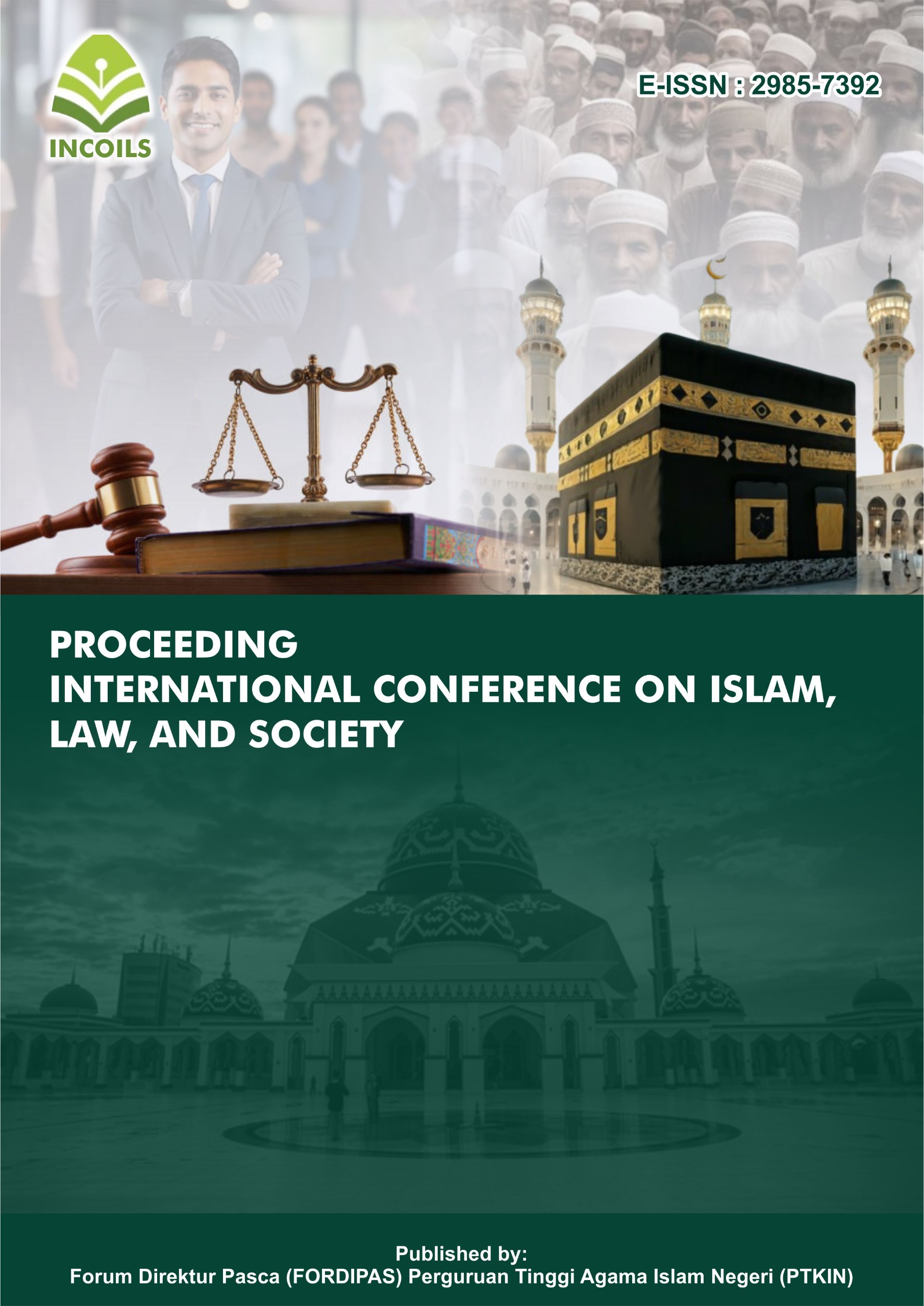
Hubb Al-Wathan VERSE AND HADITH ON PATRIOTISM AND NATIONALISM (Love of the Homeland)
hubb al-wathan" can be briefly understood as the feeling of love for the region or country that we recognize as our homeland, manifested by obeying the regulations set therein and preserving the cultural traditions of that country. Meanwhile, nationalism is an ideology or movement that states every individual must have loyalty or high allegiance dedicated to their country and nation. From this, a strong feeling toward one’s homeland arises, related to social and cultural traditions as well as the official leaders of the country. Nationalism can also be defined as a nationalistic ideology that unites the integrity of a territory or homeland, wherein this ideology is bound by solidarity between individuals or groups within the context of communal life.
DOI:
https://doi.org/10.70062/incoils.v5i1.473Keywords:
Nationalism, hadith, historical, sacrifice.Abstract
Islam does not only teach about matters of worship, but also about love for one’s homeland and nationalism, which should be deeply instilled within it. This serves as a response to certain groups who claim that “hubb al-wathan” (love of the homeland) contradicts this religion. In fact, there are many hadiths and accounts from the life of the Prophet that show historical evidence of this. They tell how Medina became the first national city with Muslims as its citizens and the Prophet Muhammad as a pioneer of a successful government based on religious principles. It is also recorded how the Prophet and his companions demonstrated their love for their homeland through their attitudes, sacrifices, and prayers.References
Al-Qur‟anal-Karim. (2009) terj.Lajnah Pentashih Mushaf al-Qur‟an Departemen
RI,Bandung: Sygma Eamedia Arkanleema.
Armawy, Armady. (2019) Nasionalisme Dalam Dinamik Ketahanan Nasional.Cet.
Ke1,Yogyakarta: Gajah Mada University Press.
Asqolany al-, Ibnu Hajar. (2017) Fathul Bari. Beirut: Dar al-Kutub al-Ilmiyah.
Basya, Ahmad Fuad. (2015) Sumbangan Keilmuan Islam Pada Dunia.terj. Masturi
Irham.Cet. Ke-1,Jakarta Timur: Pustaka al-Kautsar.
Mubarakfury al-, Shafiyurrahman. (2018) Sirah Nabawiyah.terj. Kathur Suhardi.Cet.
Ke-50, Jakarta Timur: Pustaka al-Kautsar.
Mufaizin. Nasionalisme Dalam Perspektif AL-Qur’an Dan Hadits. Jurnal. Dosen PAI
STAI Bangkalan.
Nailul Huda dan Hamim H. (2018).Cinta Tanah Air Dalam Bingkai Ihya’ Ulumuddin.
Cet. Ke-1,Kediri: Santri Salaf Press.
Sabon , Max Boli. (2019) Ilmu Negara. Cet. Ke-4,Jakarta: Univer Atmajaya
Shallabi ash-, Ali Muhammad. (2019) Ensiklopedia Perang Di Zaman Nabi.terj. Abdul
Halim.Cet. Ke-1, Solo: Zamzam.
Sholihah, Bahiyyah. (2015). Konsep Cinta Tanah Air Perspektif Ath-Thathawi Dan
Relevansinya Dengan Pendidikan Di Indonesia. skripsi. program pasca sarjana
UIN Syarif Hidayatullah,Jakarta,
Zein, Muhammad Ma‟shum. (2016) Ilmu Memahami Hadis.Cet. Ke-1, Yogyakarta:
Pustaka Pesantren
Downloads
Published
How to Cite
Issue
Section
License
Copyright (c) 2025 Proceeding International Conference on Islam, Law, and Society (INCOILS)

This work is licensed under a Creative Commons Attribution-ShareAlike 4.0 International License.