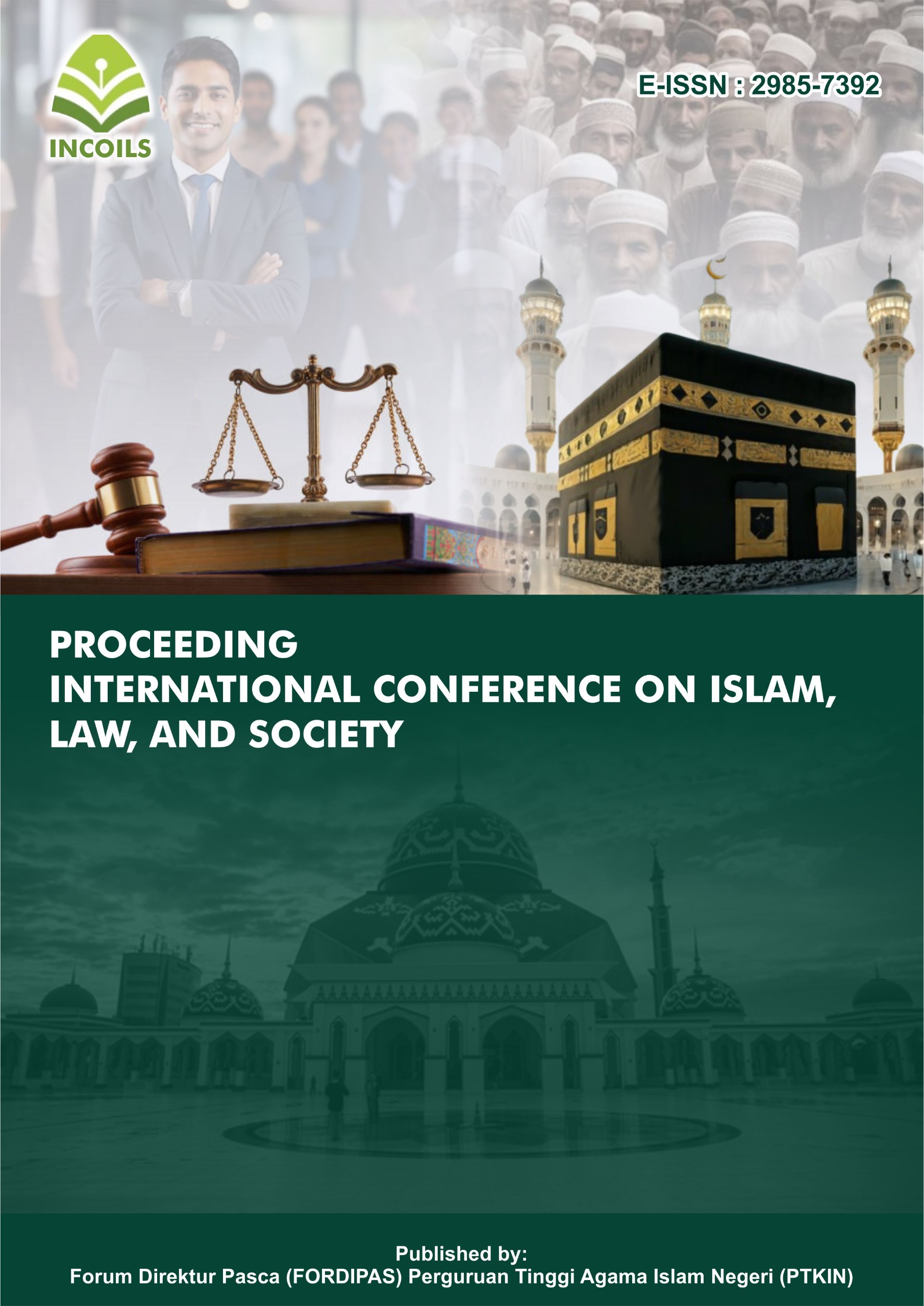
Prospects for the Application of Sharia Business Contracts in Driving Islamic Economic Growth
DOI:
https://doi.org/10.70062/incoils.v5i1.528Keywords:
Application, Business Contract, Islamic Economic GrowthAbstract
ABSTRACT : This study examines the prospects for the application of sharia business contracts in driving Islamic economic growth using a qualitative research approach. The research employs a normative qualitative literature review method that focuses on analyzing the concepts, principles, and implementation of sharia business contracts within the framework of Islamic economic development. Data were obtained from authoritative books published within the last ten years and peer-reviewed national and international journals published within the last five years that discuss sharia contracts, Islamic economic growth, and related regulatory policies. Data collection was conducted through documentation techniques, while data analysis was carried out using descriptive-analytical methods with content analysis to systematically interpret relevant literature. The research questions are directly linked to the research title by exploring the forms of sharia business contracts, their role in supporting Islamic economic activities, and the opportunities and challenges in their application to stimulate economic growth. The findings indicate that sharia business contracts such as mudharabah, musyarakah, murabahah, and ijarah have strong prospects in driving Islamic economic growth, particularly when supported by adequate regulatory frameworks, government policies, and increasing public awareness. However, challenges remain in terms of sharia literacy, institutional readiness, and integration across economic sectors. This study concludes that strengthening the application of sharia business contracts requires comprehensive strategies involving regulatory reinforcement, stakeholder collaboration, and continuous education to optimize their contribution to sustainable Islamic economic growth. Key words: Application, Business Contract, Islamic Economic GrowthReferences
BIBLIOGRAPHY
Adiwarman A. Karim. 2024, Islamic Banking: Fiqh and Financial Analysis. Third edition. Jakarta: RajaGrafindo Persada.
Agenda. Journal of Asian Finance, Economics and Business, 7(11), 1077–1085.
Ahmed, H., Ahmad, N., & Khan, A. (2023). Efficiency and Productivity of Islamic Banks in OIC Countries. In Islamic Banking and Finance in the European Union (pp. 109–125). Springer.
Aisen, A., & Veiga, F. J. (2023). How Does Political Instability Affect Economic Growth? European Journal of Political Economy, 29, 151–167
Alam, N., Abdullah, N., Salim, M., & Mohamad, M. (2021). Sustainability of Islamic Finance: A Conceptual Analysis. Sustainability, 13(3),
Alam, N., Abdullah, N., Salim, M., & Mohamad, M. (2021). Sustainability of Islamic Finance: A Conceptual Analysis. Sustainability, 13(3).
Amalia, Feby Ayu. (2022). Sharia Contract Law: Islamic Family Journal. Vol 3. no 1. 77.
Ardi, Muhammad. (2022). Principles of Agreement (Akad): Sharia Contract Law in the application of salam and Istisna. Dictum Law Journal. Vol 14. no 2.: 265
Dinar Standard. (2020). State of the Global Islamic Economy Report. Jakarta: Media Press, hlm 87
Fuady, Munir. (2021). Contract Law (from a Business Law Perspective). Bandung: Citra Aditya Bakti. 2021: 8.
Harris, D. (2020). Literature Review and Research Design. Routledge. Vintagei, p 87.
Heri Sudarsono. 2025, Islamic Banks and Financial Institutions: Description and Illustration. Yogyakarta: Ekonisia.
Iqbal, M., & Mirakhor, A. (2007). Introduction to Islamic Finance: Theory and Practice. John Wiley & Sons.
Muhammad Syafi'i Antonio. 2021. Sharia Banking from Theory and Practice. Jakarta: Gema Insani.
Muslih. (2020). Legal Consequences of Contracts (Akad) on Subjects and Objects: Supremacy of Law. Vol. 7. No. 2. (November 2018): 3
Musthafa Dib Al-Bugha. 2020. Smart Book of Sharia Transactions translated by Fakhri Ghafur. Jakarta: Hikmah.
Sari, Nilam. (2025). Contracts (akad) and their implementation in Islamic banking in Indonesia. Banda Aceh: Pena, 2025.
Veithzal Rivai and Adriana Permata Veithzal. 2020 Credit Management Handbook: Theory, Concepts, Procedures, and Applications: A Practical Guide for Bankers and Customers. Jakarta: Rajagrafindo Persada.
Veithzal Rivai and Adriana Permata Veithzal. 2020. Islamic Financial Management: Theory, Concepts, and Applications: A Practical Guide for Financial Institutions, Customers, Practitioners, and Students. Jakarta: Rajagrafindo Persada
Yulianti, Rahmani Timorita. (2022). Principles of agreements (Akad) in Sharia contract law.” La_Riba 2, no. 1 (July 3, 2022)
Zainul Arifin, Basics of Islamic Bank Management, 2022. Jakarta, Alvabeta and Tazkia Institute
Downloads
Published
How to Cite
Issue
Section
License
Copyright (c) 2025 Proceeding International Conference on Islam, Law, and Society (INCOILS)

This work is licensed under a Creative Commons Attribution-ShareAlike 4.0 International License.